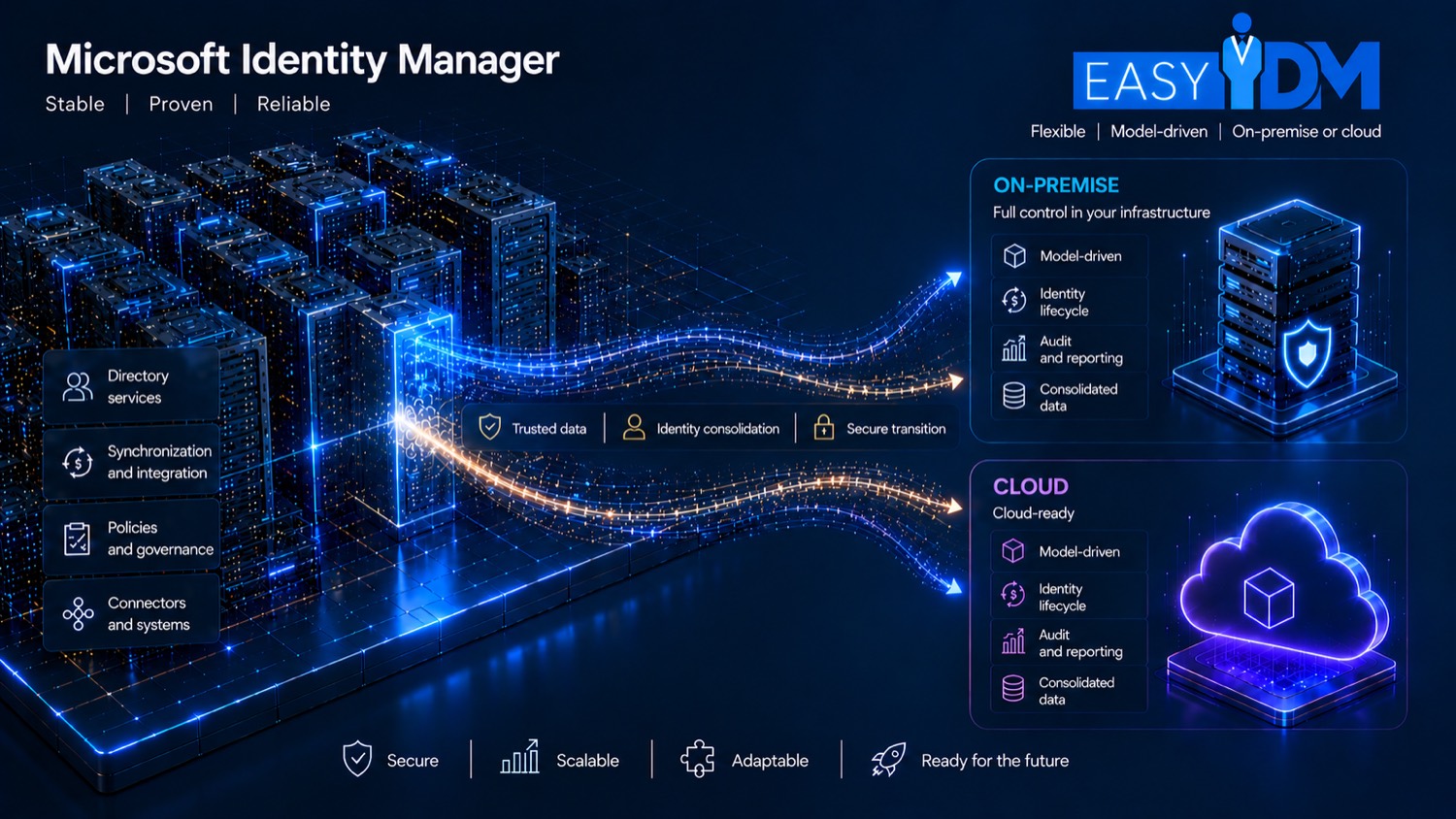
Migrating from Microsoft Identity Manager? A Structured Path Forward.
A phased, controlled transition from MIM to a modern, model-driven IAM & IGA platform – at your own pace.
Microsoft Identity Manager has been a dependable part of enterprise IAM architecture for a long time – and for many organisations, it still is. The integrations, business logic, and processes built around it over the years represent real, hard-won investment. We’re not here to tell you to throw that away.
We’re here because we’ve spent more than a decade on the other side of MIM projects – implementing it, extending it, and eventually encountering the same limitation again and again: every process change, every exception, every new business role required developer involvement. That’s the specific problem EasyIDM was built to solve.
Why Organisations Are Starting to Plan Ahead
MIM has moved into long-term maintenance mode: Microsoft continues to provide security updates, but active development has effectively stopped, and Microsoft’s own guidance increasingly points customers towards newer identity platforms.
Microsoft has also been open about its own direction: its published guidance frames cloud-first identity management, built around Microsoft Entra ID Governance, as the strategic path forward. That’s a reasonable choice for many organisations – but not the only one.
A large share of the organisations we talk to still need – or simply prefer – to keep identity infrastructure on-premise, for regulatory, operational, or architectural reasons. EasyIDM was built for exactly that flexibility: on-premise remains a fully supported, first-class option, not a legacy fallback. And for organisations that do want to move to the cloud, that path is just as open – the choice is yours to make, not one the platform makes for you.
What You Keep
Continuity, not a rebuild
We work with the integration logic, rules, and processes already running in your organisation, rather than asking you to redesign everything from scratch.
A gradual, controlled transition
The move to EasyIDM is planned as a managed, phased process that builds on your existing IAM logic, preserves operational continuity, and avoids unnecessary risk.
A modern IAM foundation
EasyIDM brings identity and access management, workflow, audit, and compliance together in one environment – without locking you into a single deployment model. On-premise, hybrid, or cloud all remain open, depending on what makes sense for you.
How the Transition Works
We treat this as a managed, staged process rather than a single cutover:
- Assessment – a structured review of your current MIM environment: connectors, rules, workflows, and dependencies.
- Target architecture – a design for where things are going, on-premise, hybrid, or cloud, based on your operational and regulatory needs.
- Test & pilot – validation in a controlled environment before anything touches production.
- Production rollout & handover – a planned cutover with full knowledge transfer to your team.
Because our team has spent years on MIM projects specifically, we can usually tell early on which parts of your setup translate cleanly and which need more careful handling – before that becomes an expensive surprise mid-project.
FAQ
Is Microsoft Identity Manager still supported?
MIM has entered long-term maintenance mode: Microsoft continues to provide security fixes, but no new features or functional updates, with extended support running through January 2029. Many MIM customers are already planning their next steps rather than waiting for that deadline.
Do I have to move to the cloud to leave MIM?
No. EasyIDM supports on-premise, hybrid, and cloud deployment, so organisations that need to keep infrastructure on-premise for regulatory or operational reasons can do so while still modernising away from MIM.
How is EasyIDM different from Microsoft Entra ID Governance?
Microsoft Entra ID Governance is Microsoft’s own cloud-first path forward from MIM. EasyIDM is built for organisations that want a model-driven, no-code platform with the flexibility to stay on-premise, go hybrid, or move to the cloud on their own timeline – without being tied to a single vendor’s cloud roadmap.
What happens to my existing MIM connectors and rules during migration?
EasyIDM allows existing notifications, connectors, and attributes to be exported from MIM and brought into the new platform, preserving prior investment in on-premise connector development rather than rebuilding your integration layer from scratch.
Planning Your Move Away From MIM?
Whether you’re running Microsoft Identity Manager today, want to stay on-premise, or are only starting to map out your options, we’ll walk through the possibilities with you and recommend a path that fits your security and operational goals.